Materials & Everyday Living
Choosing Natural-Fiber Accessories for Everyday Use
A natural-fiber label is a starting point, not a guarantee of comfort or longevity. The fiber matters, but so do the weave, seams, finish, intended use and care routine. Choosing well means looking beyond a fabric’s name to understand how it will behave in daily life.
Accessories rarely get the attention given to the larger pieces around them. A pillowcase, a travel cushion or a decorative cover may seem like a small decision. Yet these are the textiles we touch frequently, pack, wash and rely on in ordinary moments. Their usefulness rests on a practical combination: a material suited to the job, construction that can withstand it, and care instructions that fit the owner’s habits.
Natural fibers offer an appealing range of textures and performance. Linen, made from flax, has a distinctive, slightly irregular surface and is valued for breathability and durability. Silk, a protein fiber produced by silkworms, feels smooth and drapes fluidly. Cotton, another plant fiber, spans everything from crisp percale to soft sateen. None is automatically right for every accessory—or automatically better than every manufactured alternative.
The better question is not simply, “Is it natural?” It is: “Will this particular fabric, in this particular construction, work for the way I plan to use it?” That shift makes shopping less about broad claims and more about evidence a product can provide.
Start with the job the accessory has to do
Everyday use is not one condition. A pillowcase is in contact with skin for hours and needs to tolerate regular laundering. A travel pillow has to balance softness with support, remain manageable to carry and suit the circumstances in which it will be used. A decorative pillow cover may face less frequent washing but more abrasion from a sofa, pets or sunlight.
Define the task before judging the material. Ask where the piece will be used, how often it will be handled, what it will touch and how regularly it will need cleaning. A smooth fabric may feel pleasant against skin, while a more textured fabric can bring a relaxed look and a different tactile character. Neither trait, by itself, tells you whether the seams or closures will hold up.
- For close skin contact: consider surface feel, breathability, seams and whether the care routine is realistic.
- For travel: look at the total construction, including fill, casing, dimensions and packing practicality.
- For decorative use: weigh appearance against abrasion, sunlight and the likelihood of spills or frequent handling.
- For frequent washing: prioritize clear care guidance and a construction designed for repeated use.
These questions keep the decision grounded. A fiber’s reputation cannot compensate for a poor fit, an awkward closure or a maintenance routine that is too demanding to follow.
Understand what the fiber can—and cannot—tell you
Linen: textured, breathable and made to relax
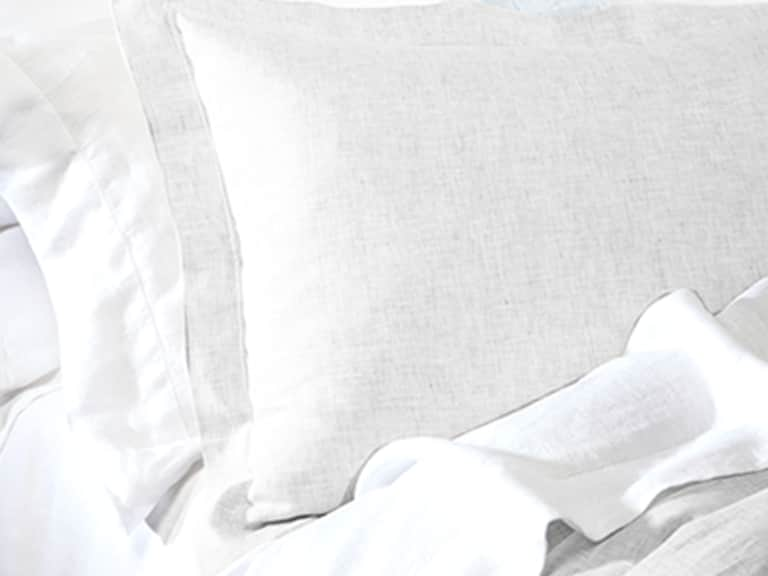
Linen is spun from flax fibers. Its natural character is visible: the surface may be gently uneven, and the cloth can feel crisp at first before becoming softer through use and washing. The open, breathable feel that many people appreciate makes linen a familiar choice for warm-weather bedding and home textiles. Its lived-in appearance can also be part of the appeal; it is not a fabric that must look perfectly smooth to look cared for.
That texture has practical implications. Linen may crease more readily than smoother fabrics, and the result depends on the weave, finishing and laundering. If a pressed, uniform surface is essential, that may be a poor match. If a soft, relaxed finish is welcome, the same characteristic can feel entirely appropriate. Fiber origin, weaving location, weight and finish are separate details, so it is worth checking each rather than treating “linen” as a complete specification.
For a bedding accessory made from flax, the DownTown Company Layla Linen Pillowcases offer a concrete example: they are described as 100% flax linen, woven in Portugal, and available in Standard/Queen and King sizes. The product information notes breathability and that the fabric softens over time. Those specifics—fiber content, dimensions and stated care characteristics—are more useful than a general promise of natural comfort.
Silk: smoothness with a more careful routine
Silk has a distinctly smooth hand and subtle luster, but it should not be confused with a plant-based fiber: it is a natural protein fiber. Its surface can make it appealing for accessories that rest against skin or hair. Still, “silk” alone leaves important questions unanswered. Is the piece entirely silk, or does the description refer only to one layer? What is the casing made from? Does it contain a separate fill? And what washing method is recommended?
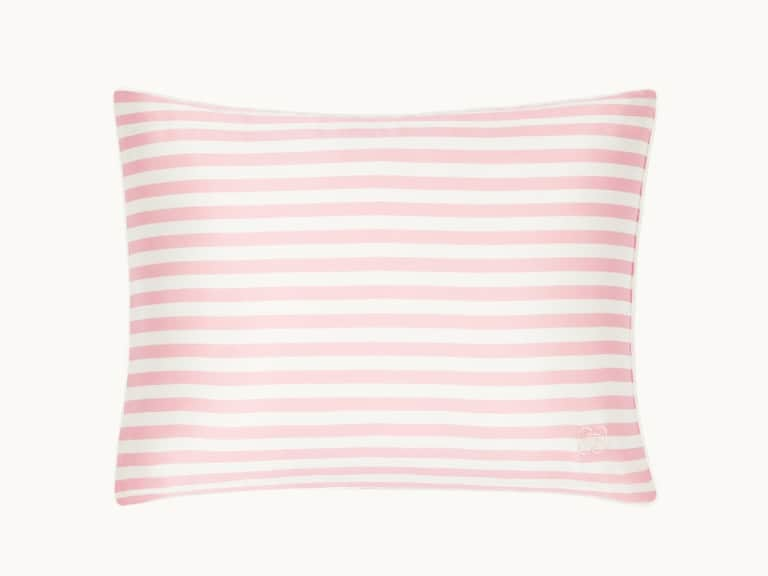
These distinctions matter especially for an accessory with multiple components. The Silk Travel Pillow in Pink & Ivory Stripe, for example, is described as having a 100% mulberry silk exterior at 19 momme, a cushion casing of 100% cotton sateen and a filling made from silk wrapped around a polyester core. That is not a contradiction; it is a layered construction. Understanding the parts helps set sensible expectations for feel, support and upkeep.
Silk products often call for gentler handling than robust everyday cloth. Follow the specific label rather than assuming that all silk can be washed the same way. The Lily Of The Valley Silk Pillowcase, for instance, is described with hand-painted floral detailing and instructions to wash inside out on a delicate cycle at no more than 30°C, air dry and cool iron. A beautiful finish is part of the design, but it also makes following the care directions especially important.
Cotton and blends: construction sets the character
Cotton can feel cool and crisp, smooth and lustrous, or substantial and sturdy, depending on fiber quality, yarn, weave and finish. A cotton sateen, for example, typically presents a smoother face than a plain weave. Blended constructions can combine different properties, but they also require a closer look at the material breakdown. A product name may foreground one fiber while the casing, lining or fill introduces another.
This is why natural-fiber shopping benefits from precise reading. Look for percentages, not just broad descriptions. If a product is filled, lined or backed, find out what those parts contain. If those details are missing, avoid making assumptions about the whole object from the name of its outer fabric.
Construction is where everyday performance is decided
The fiber supplies possibilities. Construction determines how those possibilities are used. Weave affects the cloth’s density and surface; weight influences drape and substance; seams and closures influence stability and ease of use. Two accessories bearing the same fiber label can behave differently because they were made differently.
Inspect, or seek clear descriptions of, the details most relevant to the job:
- Weave and fabric weight: A specification such as grams per square metre or momme gives more information than a claim that a fabric is “light” or “luxurious.” These measurements describe different textiles in different ways, so compare like with like.
- Seams and edges: Look for neatly finished seams, secure hems and details that are unlikely to unravel during ordinary handling.
- Closures: Buttons, zippers and envelope constructions affect how easily an accessory can be used and whether the contents stay in place.
- Filling and casing: A pillow’s outer fabric is not the whole story. Fill composition and casing can alter its structure, weight and care needs.
- Fit and dimensions: Check measurements against the pillow, bag or other item the accessory must fit. A beautiful textile that does not fit the intended object is not a useful one.
- Finishes and decoration: Printing, embroidery, piping and hand-painted details add character, but may call for more careful washing or handling.
Good construction does not have to be elaborate. Often, the useful details are quiet: a cleanly finished edge, a closure that works without fuss, or a removable cover that makes cleaning manageable. When product descriptions give concrete specifications, they let a shopper assess those details rather than rely on adjectives.
Care is part of the purchase decision
Care instructions are not a footnote. They are a preview of the relationship you will have with an accessory. A piece that requires delicate washing, air drying and careful ironing may be a good choice for someone willing to provide that attention. It may be inconvenient for someone who needs a quick wash-and-dry routine. Neither preference is wrong; the mismatch is the problem.
Before buying, read the care label or product guidance in full. Note the water temperature, cycle, detergent recommendations, drying method and whether the item should be washed inside out or separately. For decorated fabrics, closures and trims, the gentlest method specified by the maker is usually the most prudent starting point. Avoid assuming that a natural fiber is indestructible, or that a delicate one cannot be practical when handled correctly.
For washable linen, general directions often emphasize a mild detergent, room for the fabric to move and avoiding excessive heat. But the item’s own instructions take precedence. A particular finish, dye or construction may require different treatment. With silk, low temperature and gentle handling are commonly specified; instructions vary by product, so do not transfer one item’s care routine automatically to another.
Care also affects how an accessory looks over time. Sunlight can gradually alter colors, especially where textiles sit in a bright window. Repeated friction may change a surface, while over-drying can put avoidable stress on fibers. Simple habits—airing items, addressing spills promptly and storing textiles away from prolonged direct sun—can help keep them in service longer.
Durability is not only a question of how strong a fiber is. It is also about whether the accessory can be cleaned, repaired or refreshed without undue difficulty. A removable cover, replaceable insert or straightforward wash routine can matter as much to long-term usefulness as the material itself.
Look carefully at sustainability claims
Natural origin does not automatically settle environmental questions. Growing a fiber, processing it, dyeing it, transporting it and making it into a finished product all involve decisions with consequences. Nor does the word “natural” explain working conditions, chemical use or what happens at the end of a product’s life.
When sustainability matters, seek information that is specific and verifiable. Does the description identify the fiber source, manufacturing location or relevant certification? Does it explain what the certification covers? A certification can provide useful information about defined standards, but it does not answer every question about a product. Treat exact claims as more helpful than a general green label, and distinguish what is documented from what is merely implied.
Longevity is another practical part of the picture. An accessory that suits its purpose, is cared for properly and remains useful may be preferable to one that is quickly discarded. Before replacing a piece, consider whether a simple repair, a fresh insert or a different care approach could extend its use. A measured purchase—chosen for fit, function and realistic maintenance—is often a more meaningful step than buying something solely because it carries a natural-fiber description.
A short checklist before you choose
When comparing natural-fiber accessories, use this checklist to bring the decision back to everyday needs:
- Name the use. Decide whether the item will be worn, carried, slept on, displayed or handled regularly.
- Confirm the fiber content. Check percentages and identify the material of any lining, casing, backing or fill.
- Assess the construction. Look for clear information about weave, weight, seams, closures, finish and dimensions.
- Match texture to preference. Choose a smooth, crisp or relaxed feel because you enjoy it—not because one texture is presented as universally superior.
- Read the care instructions. Be honest about whether you will follow them. A care-intensive item can be worthwhile, but only if the routine suits you.
- Consider the setting. Think about heat, sunlight, moisture, friction and the likelihood of spills.
- Check claims in context. Look for specific sourcing or certification information, and avoid treating vague environmental language as proof.
- Choose for continued use. The best option is one you will want—and be able—to keep using.
The best choice is the one that fits real life
Natural-fiber accessories can bring comfort, texture and lasting character to familiar routines. Linen offers a relaxed, breathable feel; silk brings a smooth surface and a more particular care conversation; cotton can take many forms depending on its weave and finish. Each material has strengths, limitations and variations that no label can fully summarize.
Look at the whole object. Ask what touches the skin, what supports the shape, how the edges are finished and how the piece must be cleaned. Compare stated facts rather than relying on sweeping claims. The result need not be the most expensive or the most delicate option. It should be the one whose feel, construction and upkeep make sense for the life it will actually lead.
That is a modest standard, but a useful one. An accessory chosen with care does not need to announce itself. It simply works—day after day, wash after wash, and in all the ordinary moments that make a household feel like home.