Bedding · Buying guide
How to Evaluate Silk Bedding Weight and Weave
Thread count can make cotton sheets sound easy to compare. Silk asks a different set of questions: How much does the fabric weigh? What kind of silk is it? How is it woven and finished? Here’s how to read those details—and why no single number tells the whole story.
Silk bedding is often presented with the language of luxury: fluid drape, a quiet sheen, a cool touch. Yet choosing it well is less a matter of chasing the most impressive-sounding specification than understanding what the specifications can—and cannot—tell you. For silk sheets and pillowcases, the usual shorthand of cotton bedding, thread count, is not the most useful place to begin.
A more relevant measure is momme, a unit used to describe silk fabric weight. Then come the finer details: fiber type, weave, finish, seams, closures and care instructions. Together, these provide a more practical portrait of how a piece may feel, how it is constructed and what it will ask of its owner.
This distinction matters when considering Gingerlily silk bedding. Several items in the range specify 100% mulberry silk and a weight of 19 momme; some fitted sheets are listed at 22 momme. Those numbers offer useful points of comparison, but they are not grades, guarantees of longevity or a substitute for checking construction and care. A thoughtful decision starts with the whole fabric—not a single figure on a product page.
Why thread count is not the headline for silk
Thread count describes the number of threads in a square inch of woven fabric. It is commonly used to compare cotton bedding, although even for cotton it is not a complete measure of quality. The way yarn is made, the type of fiber, the weave and the finishing all matter. A large thread-count number alone cannot describe the softness, strength or comfort of a sheet.
Silk is usually described differently. Its yarns and fabric constructions are not typically compared using the thread-count language shoppers encounter with cotton. Rather than using a cotton metric as a universal score, look for details that are relevant to the silk product itself: fiber composition, momme weight, weave or finish when specified, and the maker’s care guidance.
This is not a reason to dismiss product information that mentions thread count in another context. A silk-filled pillow, for example, may have a cotton sateen cover whose thread count is stated separately from the silk filling. That figure describes the cotton cover, not the weight or weave of the silk. The distinction between the casing and the filling is essential when reading mixed-material specifications.
For shoppers searching “silk sheet thread count,” the short answer is that momme and construction are usually the better starting points for silk fabric. Thread count may still appear in descriptions of companion materials, but it should not be treated as a like-for-like measure of silk bedding.
Momme: a useful measure, not a quality verdict
Momme (often written “mm”) is a traditional measure of silk fabric weight. It gives shoppers a way to compare the stated weight of silk textiles, especially when evaluating items made from the same type of silk. It is not the same as thread count, and a higher momme figure does not automatically mean a better choice for every person or every use.
In practical terms, a fabric’s weight can contribute to its hand and drape. A lighter silk may feel more delicate and fluid; a heavier one may feel more substantial. But these are broad impressions, not promises. The yarn, weave, finishing and garment or bedding construction also influence how a piece behaves. Even the same nominal weight can feel different across products and makers.
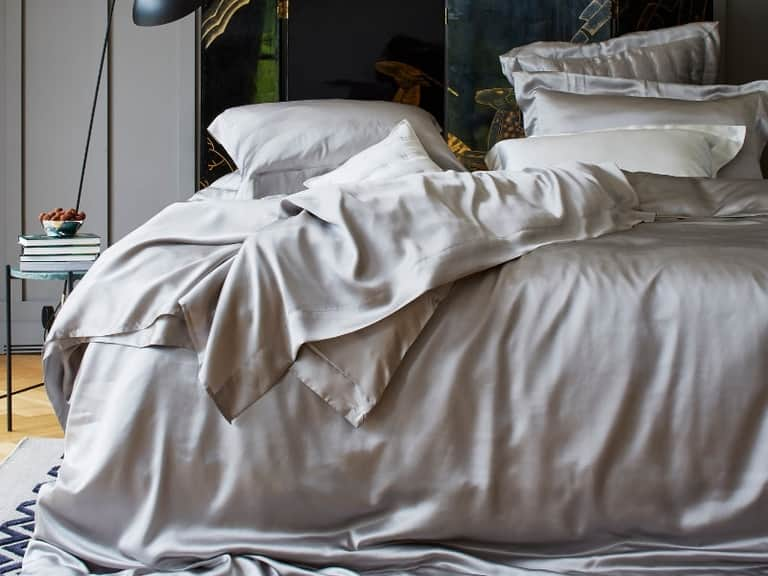
Gingerlily product details provide concrete examples of how to use the number without overreading it. The Silver Grey Silk Pillowcase is described as 100% mulberry silk at 19 momme. Its specification also identifies a knife-edge finish and envelope closure, as well as delicate-cycle washing guidance. A shopper can consider those details together: the stated fiber, weight, finish, closure and care routine all help describe the pillowcase.
Some Gingerlily fitted sheets are listed at 22 momme, while a number of flat sheets and pillowcases are listed at 19. That variation can help distinguish items in a range, but it should not be converted into a simplistic ranking. The right weight depends on preference, intended use and the full construction of the item. A heavier figure is not a universal guarantee of a softer feel, a longer lifespan or better sleep.
It is also worth checking that the stated weight belongs to the textile you are evaluating. Bedding may include multiple components: a silk shell, a cotton cover, a mixed filling or decorative trim. Read each material line closely rather than assuming that one number describes every component.
Fiber type and fabric construction
“Silk” is a broad material description. Product listings may identify mulberry silk, long-strand mulberry silk or simply silk. These terms tell you something about the stated material, but they do not independently reveal every detail of sourcing, grading or manufacturing. If a listing makes a specific claim that matters to you, look for the precise composition and any supporting information provided by the maker.
Construction deserves equal attention. Weave is the arrangement in which yarns cross to form fabric. It affects the fabric’s surface, drape and appearance, and different constructions can make materials feel distinct even when fiber content is similar. Yet product pages do not always name a specific weave for silk bedding. If the weave is not stated, avoid guessing from a photograph or assuming that a familiar term applies.
Other construction details can be more immediately visible in a written specification. A pillowcase might have an envelope closure, a knife edge or an Oxford-style border. A duvet cover may have buttons or an envelope closure, and some designs include internal ties. A fitted sheet’s pocket depth and elastic construction matter to fit. These features are not measures of silk quality, but they affect how the textile functions in daily use.
Finish and design can influence a shopper’s impression, too. A plain, smooth surface and a printed or bordered design may have different visual effects, even where both use silk. For a considered purchase, separate aesthetic preference from material specification: the color, border and motif help define the look, while fiber, weight, construction and care describe other aspects of the product.
How to compare Gingerlily silk bedding
When comparing Gingerlily bedding, use a small checklist rather than one headline number. Start with composition. Does the listing state 100% mulberry silk, or does the item combine silk with another fiber? For a pillow, distinguish the outer cover from the filling and any support core. A product title may foreground “silk” while the detailed specifications explain that the construction includes additional materials.
Next, note the momme weight and what it refers to. A 19-momme silk pillowcase and a silk-filled pillow are not necessarily comparable items, because the latter may involve multiple layers and materials. Compare like with like where possible: pillowcase with pillowcase, flat sheet with flat sheet, fitted sheet with fitted sheet.
Then examine the details that shape use. For fitted sheets, check the listed pocket depth against the mattress, including any topper. For pillowcases, look at closure and dimensions. For duvet covers, check how the cover closes and whether internal ties are specified. Product descriptions may vary in the amount of detail they supply, so note what is stated rather than filling gaps with assumptions.
For instance, the Silver Grey Silk Pillowcase brings together 100% mulberry silk, a 19-momme weight, a knife-edge finish and an envelope closure. Those are useful, concrete comparison points alongside its silver-grey color and care instructions. Another 19-momme pillowcase could have a different border, closure or finish; the shared weight would not make the two identical.
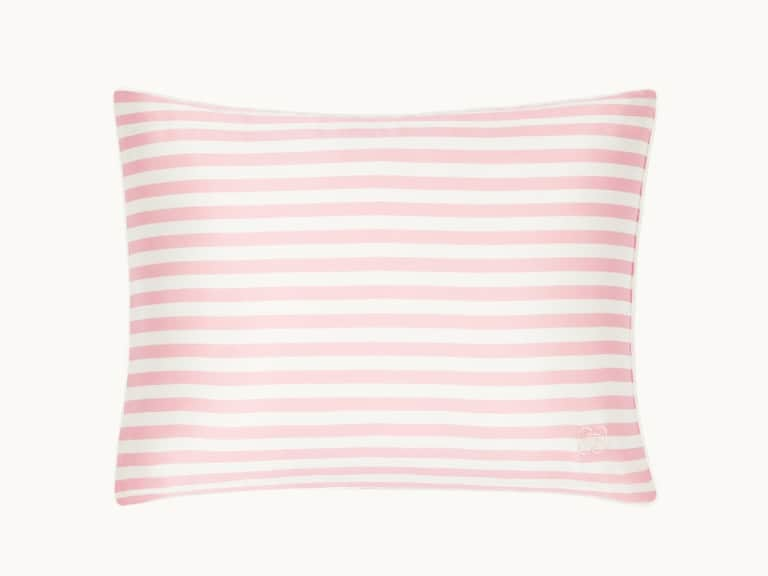
For travel, the Silk Travel Pillow – Pink & Ivory Stripe illustrates why component-by-component reading matters. Its description specifies a silk surface at 19 momme, a filling made from silk wrapped around a polyester core, and a cotton sateen casing. The stated 300 thread count belongs to that cotton casing; it is not a thread-count rating for the silk. The distinction is useful well beyond travel accessories: bedding descriptions may combine materials that each have their own specifications.
Weave, feel and the limits of online descriptions
A weave can be a meaningful part of fabric character, but the term needs context. Different weaves organize yarns differently, producing variations in surface, drape and structure. In silk bedding, however, a listing may provide the fiber and momme weight without naming the weave. That is not an invitation to infer a technical specification from a product photograph. When the information is absent, the honest conclusion is that it has not been supplied.
Descriptions such as “smooth,” “soft” or “lustrous” can help communicate an intended impression, but they are not standardized measurements. How fabric feels is also personal. Climate, room temperature, sleep habits and individual sensitivity can affect what seems comfortable. If possible, handle silk in person before buying. If shopping online, use specific material details and the return policy alongside descriptive language.
Claims about silk’s relationship to skin, hair, temperature or allergies should also be read with care. Silk can feel smooth against the body and is often chosen for that tactile quality. But bedding is not a medical treatment, and promotional descriptions should not be mistaken for a promise of a health result. Individual experiences vary, and comfort is only one part of a useful bedding decision.
Care is part of the buying decision
The most persuasive specification can become a poor fit if the recommended care does not suit your routine. Silk bedding is often accompanied by instructions for delicate washing, mild detergent, air drying and cool ironing, but directions differ by item. Follow the care label for the specific product rather than applying one general rule to every silk textile.
Before purchasing, ask yourself whether you are comfortable separating delicate items, using a gentle cycle and allowing time for air drying. Some pieces may have particular instructions about washing inside out, avoiding tumble drying or using a silk-specific detergent. A silk-filled pillow may have different care needs from a removable pillowcase; its cover and filling may not be treated in the same way.
Care habits can influence how a textile looks and feels over time, so they belong in the same conversation as price, weight and fiber. A product with a weight that appeals to you is not automatically the most practical choice if its maintenance requirements do not fit your household. The right bedding is not simply the most sumptuous option on paper; it is the one you can use and care for comfortably.
A practical silk bedding checklist
Before settling on sheets or pillowcases, gather the details that clarify both material and use. A short, disciplined review helps keep technical language in perspective.
- Composition: Identify the fiber content and separate the shell, cover, filling and lining if the item has multiple components.
- Momme weight: Record the stated weight, then compare it with similar products rather than unrelated bedding categories.
- Weave and finish: Check whether these are specified. Treat unlisted details as unknown, not as something to infer.
- Construction: Review closures, borders, stitching, internal ties and fitted-sheet pocket depth.
- Care: Read the exact washing and drying instructions and decide whether they fit your routine.
- Purpose: Consider whether you need a fitted sheet, flat sheet, pillowcase or decorative layer; compare items designed for the same role.
- Evidence: Distinguish measurable specifications from broad descriptions and claims about performance.
This method is deliberately modest. It does not turn a product page into a laboratory report, nor does it pretend that a handful of labels can predict every sleeper’s experience. It does, however, replace a misleading shortcut with questions that are more closely tied to the fabric and how it will be used.
The number is the beginning
Silk bedding does not need to be evaluated by cotton’s most familiar metric. Momme weight is a more relevant clue for silk fabric, while fiber content and construction help make that clue intelligible. A stated 19 or 22 momme gives a point of comparison—not a verdict on comfort, durability or value.
For Gingerlily silk bedding, read the product details as a set: what the silk is made from, how the listed weight applies, which construction features are included, and how the item should be cared for. The approach is less dramatic than a single oversized number. It is also more useful. In bedding, as in most things made to be lived with, a specification earns its meaning through the details around it.